
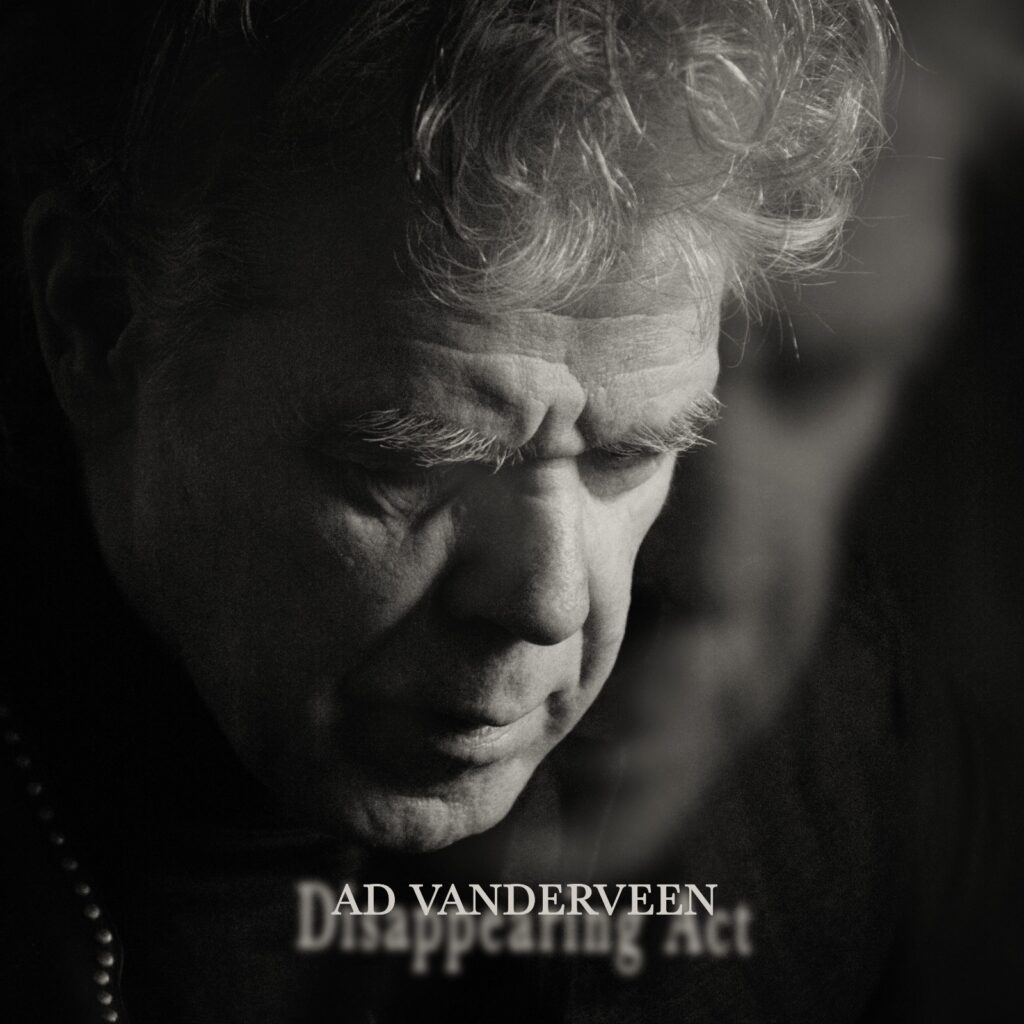
There is something quietly defiant about an artist who has spent decades making music on his own terms and simply refuses to stop. Disappearing Act, Ad Vanderveen’s 2026 release, carries that defiance in its very title. The chorus of the title track acknowledges the contradiction directly: the attempt to retreat, to step back, to let go, keeps failing because the songs keep arriving anyway. It is a fitting entry point into an album that holds withdrawal and presence in the same breath throughout its eleven tracks.
Thematically, the record sits at a particular point in a life’s arc. Vanderveen is not writing from ambition or hunger for recognition here. He is writing from a place of reflection, gratitude, and a quiet reckoning with what has been built and what remains. The tensions between inward focus and the desire to still be heard, between acceptance and drive, between disappearing and showing up, run through the album like a current. It never resolves those tensions neatly, which is precisely what gives the writing its weight.
Instrumentally, the album is generous without being cluttered. Acoustic guitar and vocal form the foundation, with violin, pedal steel, piano, mandola, dobro, harmonica, and harmony vocals layered around them in a way that feels natural rather than arranged. Moniek De Leeuw’s violin adds a plaintive quality in the right moments, while Jan Erik Hoeve’s pedal steel brings a warm Americana drift that grounds the more reflective tracks. The reunion with The Cotton Brothers adds further texture, their presence lending a sense of shared history that suits the album’s contemplative mood.
Producer Daniel Shergold captures everything with an organic, unhurried quality that suits Vanderveen’s working philosophy perfectly. Two of the eleven tracks emerged improvisationally during the sessions, and that spontaneity is audible across the record as a whole. Nothing sounds labored. The performances feel immediate and unconditional, as though the songs were committed to tape at the precise moment they existed most fully. That approach carries genuine risk, but here it pays off consistently.
The inclusion of John Gorka’s “Soliloquy” sits comfortably within the album’s framework, reflecting a sensibility that values the right song over authorial ownership. Vanderveen’s interpretive instinct is strong enough that the cover feels like a natural part of the sequence rather than an interruption. The closing track “If Words Were Notes,” which also appears as an intro at the album’s opening, frames the whole record as a meditation on the relationship between language and music, thought and expression.
Disappearing Act is the work of an artist with nothing left to prove and everything still worth saying. That distinction matters, and Vanderveen earns it.